Skip to content
QUANTUMGRIDQuantumGrid
Network PreviewBuilt for Robinhood Chain

QUANTUMGRID

Fig. 01 — Job Routing
2,841 nodes onlinechain 46630

QuantumGrid pools idle GPU, CPU, and server capacity from independent providers into a single distributed compute network. Instead of buying a supercomputer, you rent exactly the slice of one you need — and the fees that pass through the network flow back to the people who hold and secure it.

Active nodes
2,841
GPUs pooled
8K
Compute
2,385 PFLOPS
Fees routed
$101.7M
ProvidersQuantumGridUsers & Applications
Active nodes2,841
GPUs pooled8K
Network compute2,385 PFLOPS
Utilisation80%
Jobs / 24h212.9K
Fees / 24h$131.6K
Regions7
Epoch#920
01How it works

One network,
many machines.

A single company buying its own supercomputer pays for peak capacity it uses a fraction of the time. QuantumGrid inverts that: capacity already exists, scattered across thousands of machines that sit idle most of the day. The network's job is to find it, verify it, and price it.

001

Providers

GPU / CPU / Server owners

Operators connect machines and expose the capacity they are not using. The node agent benchmarks the hardware, assigns it a tier, and takes it online.

  • Idle capacity, not new hardware
  • Benchmarked into a tier
  • Bond posted in $QGRID
002Protocol

QuantumGrid

Scheduler & settlement

The scheduler places each workload on the cheapest node that satisfies its region, memory, and latency constraints, then settles payment on-chain once the work is verified.

  • Constraint-based placement
  • Redundant spot-checks
  • Per-job on-chain settlement
003

Users & Apps

Teams shipping products

Developers request compute by the hour or by the job, or call the inference gateway directly. They pay for usage, not for reserved capacity sitting idle.

  • Rent by hour or by workload
  • OpenAI-compatible API
  • No minimum commitment
02What runs on it
01

AI Inference

Serve open-weight models at production latency

02

Image Generation

Diffusion pipelines, batch or interactive

03

Video Generation

Frame-parallel generation across nodes

04

3D Rendering

Render farms without owning the farm

05

Data Processing

ETL, indexing, and large joins on CPU tiers

06

Model Execution

Scheduled batch jobs and fine-tuning runs

07

Web3 Applications

Node infrastructure, provers, and indexers

08

Scientific Compute

Simulation and analysis workloads

03$QGRID holder rewards

QuantumGrid turns compute
usage into rewards.

Most token models ask you to hold and hope. This one has a revenue line: someone rents a GPU, the job settles, and a fee lands in the treasury. What the treasury does with that fee is the entire model.

  1. 01

    Use Compute

    Workloads run on the grid and settle in stablecoins or $QGRID.

  2. 02

    Generate Fees

    Every settled job pays a protocol fee into the treasury contract.

  3. 03

    Buy $QGRID

    The treasury converts its fee share into $QGRID on the open market.

  4. 04

    Distribute Rewards

    Epoch rewards flow to stakers, providers, the treasury, and the burn.

04Revenue allocation

Every fee the network
collects, split four ways.

The split is a protocol parameter, not a policy the team can change quietly — altering it requires a governance vote. Distribution runs once per epoch against whatever revenue actually arrived.

100% of net protocol revenue, per epoch

Holder & Staker Rewards

60%

Paid to wallets staking $QGRID. Distributed per epoch, proportional to stake weight and lock duration.

Compute Providers

25%

Paid on top of job settlement to the nodes that actually served the workload. Weighted by uptime and verified output.

Development & Infrastructure

10%

Scheduler infrastructure, API gateways, security audits, monitoring, and network expansion.

Buyback & Burn

5%

Market-buys $QGRID and sends it to a burn address, permanently reducing supply as usage grows.

Rewards are a share of revenue, not a fixed rate. An epoch with no jobs pays nothing, and no yield figure anywhere on this site is a promise.

04bFor providers
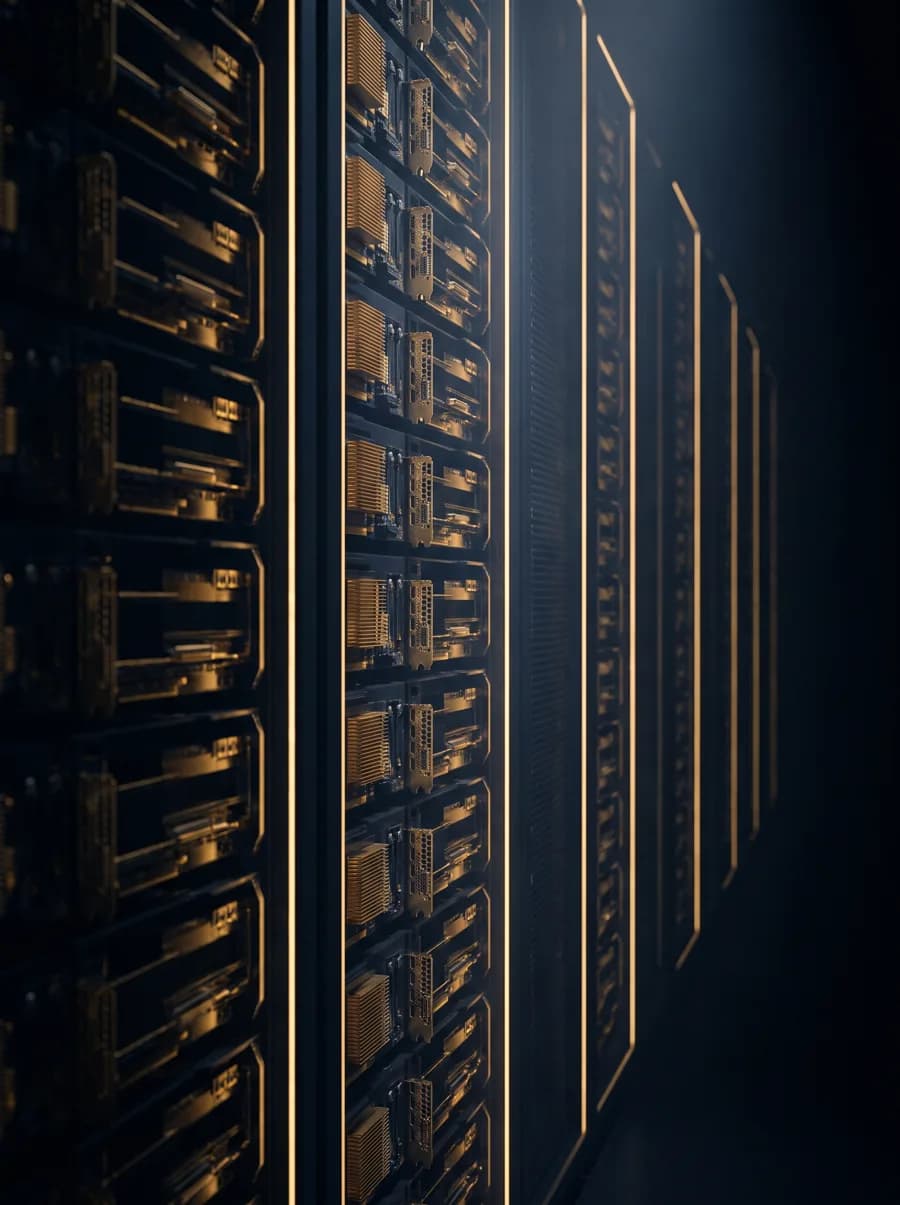
Rows of GPU compute boards mounted in dark server racks, lit along the rack edges
Fig. 02 — Provider capacityGPU / CPU

Hardware you already own,
earning while it idles.

Most GPUs spend most of the day doing nothing. Register the machine, pass the benchmark, post a bond, and the scheduler starts routing paid work to it — with earnings settled per epoch against work the network verified.

Worked example4 × RTX 4090
List rate
$0.42/h
per GPU
Utilisation
62%
assumed
Gross / day
$25.00
before fees
Bond
29,359
$QGRID

Illustrative. Utilisation is an assumption, not a guarantee, and the bond converts at a reference rate of $0.0412 because $QGRID has no market yet.

06$QGRID utility

The token does
five jobs.

A token with one use is a ticker. $QGRID is the settlement asset, the staking asset, the collateral providers put at risk, the governance weight, and the thing the treasury buys back.

001Fee discount

Compute Payment

Settle any workload in $QGRID and pay a reduced protocol fee versus stablecoin settlement.

00260% of revenue

Revenue Staking

Stake to claim a proportional share of the 60% revenue allocation, streamed each epoch.

003Collateral

Provider Bond

Providers post $QGRID as collateral to join. Bad service or manipulated results slash the bond.

004Stake-weighted

Governance

Vote on fee parameters, slashing thresholds, emission schedules, and which hardware classes qualify.

005Deflationary

Buyback Asset

The token the treasury buys and burns, tying supply reduction directly to network usage.

Provider bonding

Bad service costs the provider money.

Joining the grid means posting $QGRID as collateral, sized to roughly a month of the hardware's gross revenue. Falsified output or sustained downtime slashes part of that bond. It is the difference between a promise and a cost.

Bond calculator
07Settlement layer

Running on
Robinhood Chain.

QuantumGrid settles on Robinhood Chain — a permissionless, EVM-compatible Arbitrum Orbit L2 that posts to Ethereum and uses ETH for gas. The choice is about the shape of the traffic, not the brand on it.

Why this chain

01

Settlement is per job

A busy grid settles hundreds of thousands of small payments a day. That pattern is unusable anywhere fees are measured in dollars, and fine on an L2 with sub-cent costs.

02

Confirmations are fast enough to schedule against

Roughly 100ms soft confirmations mean the scheduler can treat payment as resolved within the lifetime of a short job instead of holding an escrow open.

03

Nothing has to be rewritten

It is a standard EVM chain on the Arbitrum Nitro stack. Existing wallets, Solidity contracts, and tooling work against it unchanged, and gas is paid in ETH.

04

Settlement inherits Ethereum

Batches post to Ethereum for data availability and final settlement, so the network's own security assumptions do not have to be taken on faith.

Network parameters

Targeting testnet
Framework
Arbitrum Orbit (Nitro)
Settlement layer
Ethereum
Data availability
Ethereum blobs (EIP-4844)
Gas token
ETH
Soft confirmation
~100 ms
Execution
Full EVM equivalence
Mainnet
4663
Explorer
Testnet
46630
Explorer

QuantumGrid is an independent project. It builds on Robinhood Chain as public infrastructure and is not affiliated with, endorsed by, or operated by Robinhood.

08Roadmap

From preview
to live revenue.

Phase 01Now

Grid Foundation

  • Scheduler and job settlement design
  • Node agent benchmark suite
  • Provider bonding parameters
  • Public dashboard preview
Phase 02Next

Testnet on Robinhood Chain

  • Deploy $QGRID and staking contracts to chain 46630
  • Onboard the first provider cohort
  • Open the inference gateway in beta
  • Third-party contract audit
Phase 03Later

Mainnet & Revenue Live

  • Mainnet deployment on chain 4663
  • First revenue epoch distributed to stakers
  • Buyback and burn contract activated
  • Governance opens to token holders
Phase 04Horizon

Open Grid

  • Permissionless provider onboarding
  • Verifiable compute attestations
  • Cross-chain settlement routes
  • Grant program for grid-native apps
09Questions

The awkward
ones first.

If a question about this model has an uncomfortable answer, it is better read here than found out later.

01Where does the reward money actually come from?

From compute that people pay for. Every settled job pays a protocol fee, and 60% of that fee is allocated to stakers. If the network serves no jobs in an epoch, there is no revenue that epoch and the reward is zero. This is a revenue share, not a fixed-rate emission.

02Why Robinhood Chain?

It is a permissionless, EVM-compatible Arbitrum Orbit L2 with roughly 100ms soft confirmations and ETH as the gas token. Per-job settlement means a very high count of small payments, and that pattern needs cheap, fast finality. Being EVM-standard also means existing wallets and tooling work unchanged.

03What stops a provider from faking results?

Providers post a $QGRID bond sized to their hardware tier before they receive jobs. Output is spot-checked by redundant execution on a sample of jobs. A mismatch, or sustained downtime against the advertised SLA, slashes a portion of the bond. The bond is what makes bad behaviour cost more than it earns.

04Do I have to hold $QGRID to use the compute?

No. Workloads can be paid in stablecoins. Paying in $QGRID gets a reduced protocol fee, and the treasury's buy pressure comes from converting its fee share on the market either way.

05Is the token live?

Not yet. $QGRID has no deployed contract, and no address on this site should be treated as one. The dashboard runs on preview data so the mechanics can be reviewed before anything is deployed. Testnet deployment is Phase 02.

06What happens to the burned supply?

5% of revenue market-buys $QGRID and sends it to an address with no known private key. It is removed from circulating supply permanently. The burn rate is a function of network usage, so it accelerates as the grid gets busier.

Dashboard preview open

Put the idle
machines to work.

Walk the whole model end to end — rent a GPU, price an inference call, size a provider bond, and see how an epoch of revenue would split.